Two Millimetres
On why I build in relief, and what a little real depth does that a flat image can't.
Two millimetres. Lay two grains of rice end to end and you have it — the whole depth of everything I make. Less than the ridge of a fingernail. On a screen you'd never see it; in a photograph it vanishes. Run your eye across one of these surfaces and it stays flat. Run a finger, and it gives itself away.
That gap — between what the eye lets pass and what the hand insists on — is the reason I build in relief at all.
Everything reaches us flat now. A peach, a face, a stone: all of it arrives at the same depth, which is no depth, lit from behind glass, smooth, endlessly replaceable. A flat image asks nothing of your body. You take it in at a glance and move on. I wanted to make something a glance can't finish.
Two millimetres is enough to catch light — real light, the kind that changes through the day. A relief has its own weather. Morning rakes across the surface and finds every carved line; by afternoon the same painting has gone quiet, the shadows filled in. Lean left, lean right, and it isn't the same image twice. You can't scroll past a thing that answers back when you move.
Underneath, it's built the slow way. Ground laid down and sanded, laid down and sanded again. Acrylic carved into while there's still something to carve. Then oil, wax, mineral pigment — layer over layer, each one waiting on the one before it to dry, to harden, to hold. Nothing here is quick. By the time a piece stands two millimetres off the panel, it has swallowed weeks.
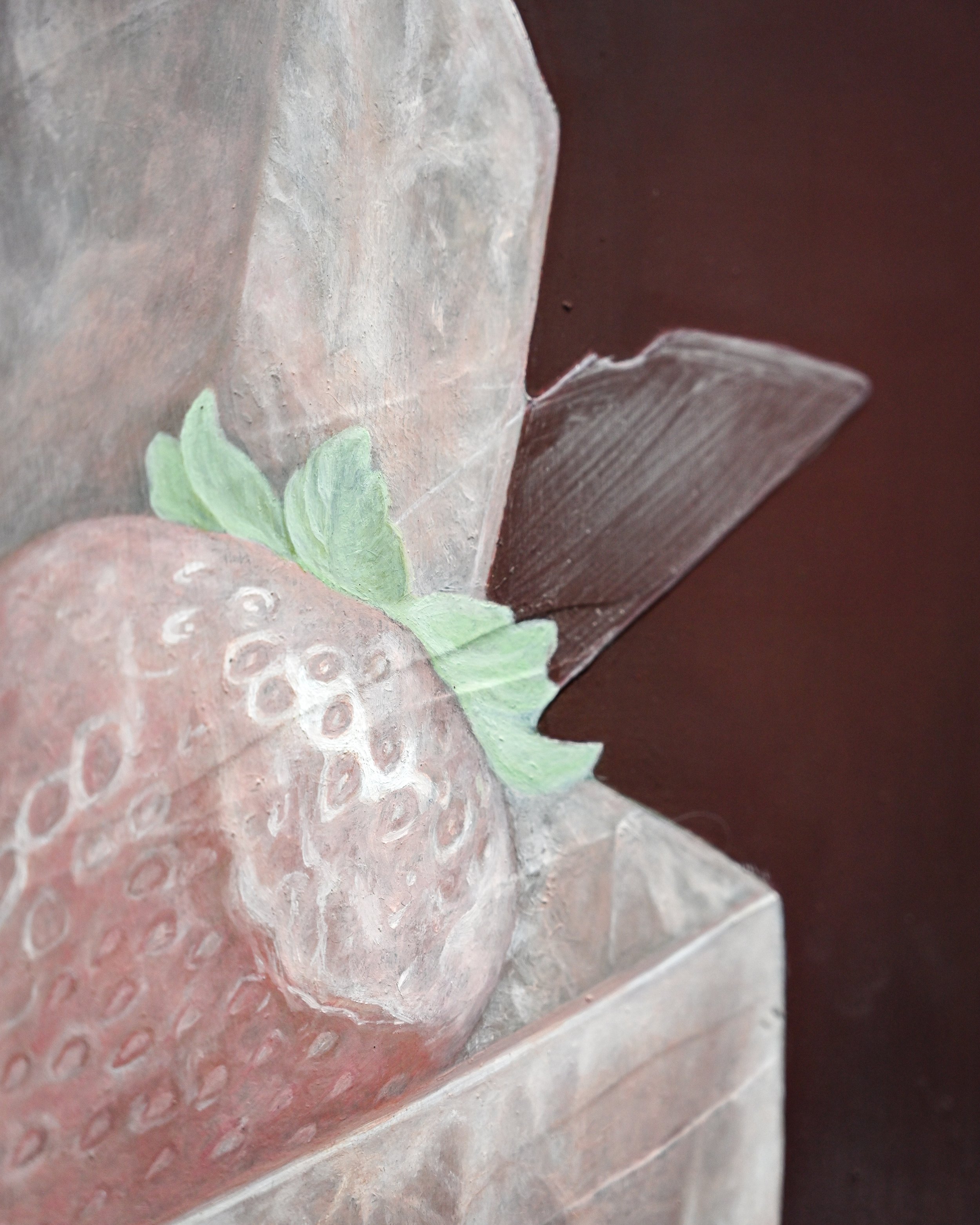
I've started to think of the surface the way you'd think of stone. Not a picture of time — time itself, pressed down and kept. Every layer is a day I can no longer see, buried under the next one. The image on top floats on all of it. That's the part I care about most: taking a throwaway picture, the kind that lives a second on a feed and disappears, and laying it down, carving it, weighting it, until it can't be thrown away. An image made too heavy to swipe.
Because it does have weight. You feel it the moment you lift one off the wall — it pushes back, the way an object does and an image never can. It takes up room in the world. It casts its own small shadow. It is a thing, not a picture of a thing.
So: two millimetres. Almost nothing. But it's the whole distance between an image you consume and an object that consumes a little of you back — your time to look, your body leaning in, the light you happen to be standing in. Everything I'm after fits inside that gap.
