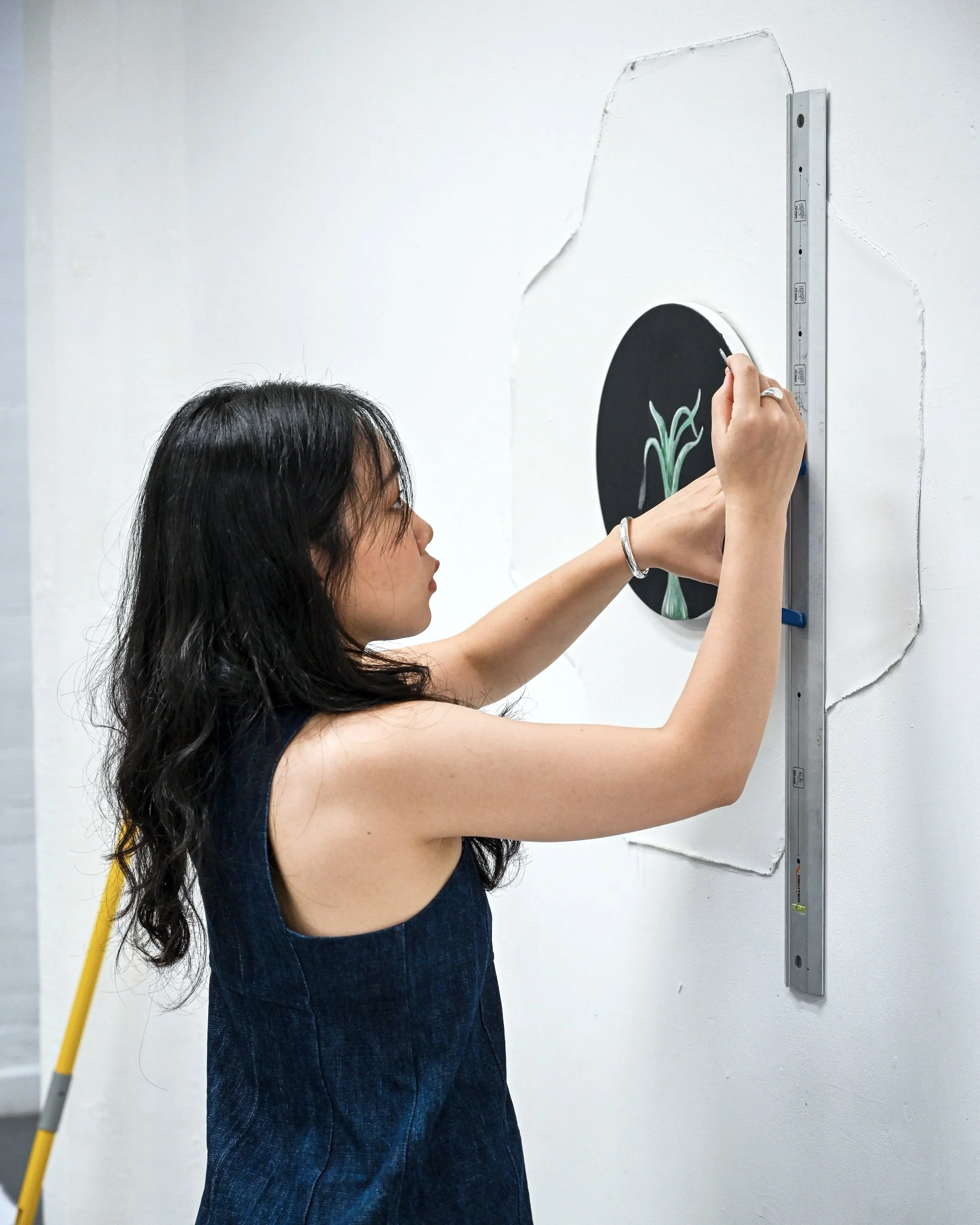
A woman with long dark hair is using a pencil to draw on a circular chalkboard mounted on a white wall. The wall has an uneven cutout around the chalkboard, and there is a yellow ladder in the background.

About Feishan Hsieh

Born in Taipei, Taiwan, in 1997. Lives and works between Paris and Taipei.

Feishan Hsieh is a visual artist working in relief painting and mixed media, using plaster, oil paint, wax, and mineral pigment to build layered surfaces with physical weight. She holds a Bachelor's degree in Fashion Design from Shih Chien University, Taipei, and completed a Fine Art Summer Session at the University of California, Berkeley, in 2020. She received her DNA (Diplôme National d'Art, 2023) and DNSEP (Master's degree, 2024–2026), both with highest honors, from the École Nationale Supérieure d'Art de la Villa Arson.

Her practice revisits the still-life tradition through the central metaphor of jade—a mineral formed under pressure, dense and layered beneath its surface. Rooted in her Taiwanese heritage and shaped by her experience between cultures, her work engages questions of memory, labor, and identity as they are formed, classified, and consumed.
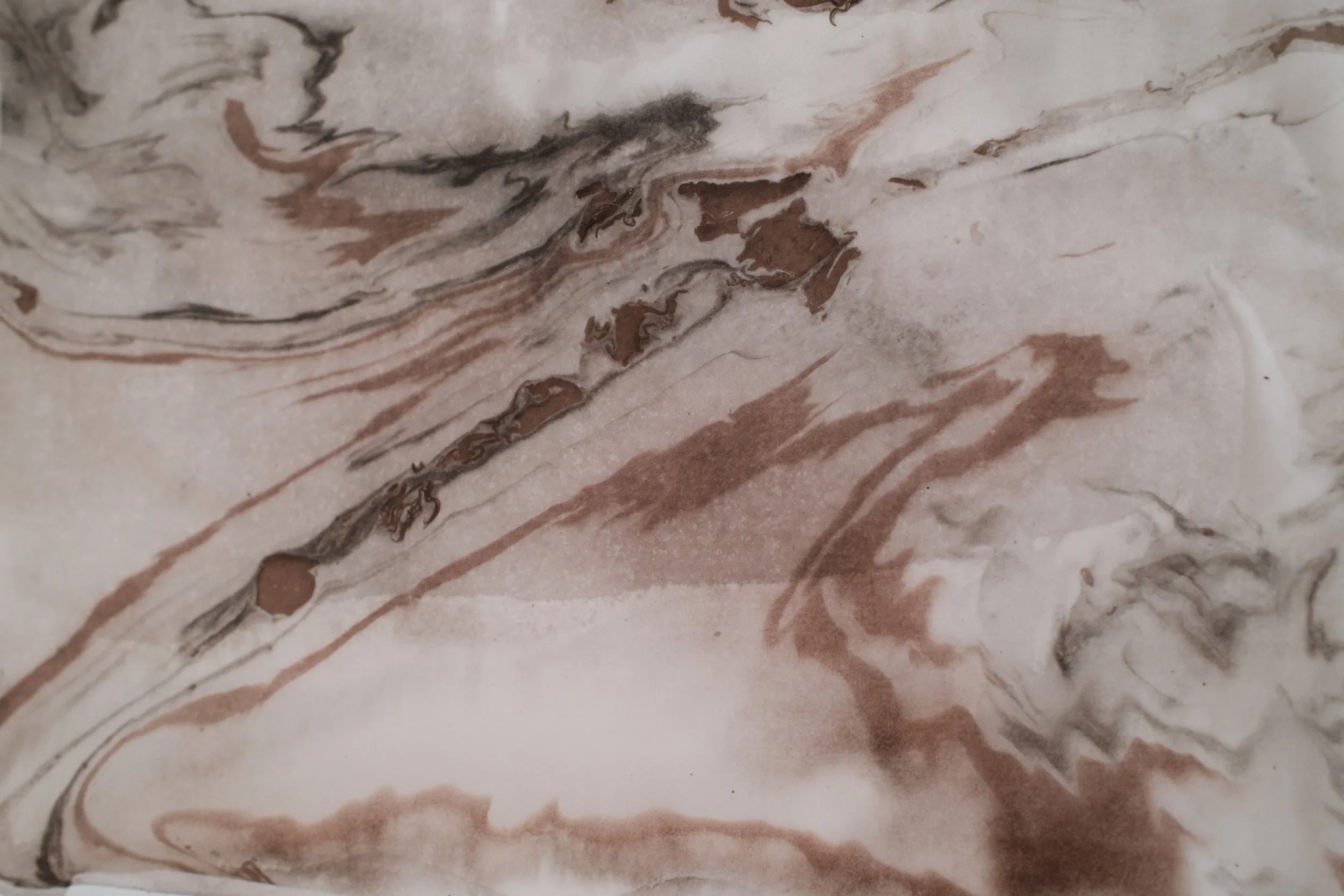
Perception, Value, and the Constructed Gaze

Themes and Research

Feishan's work examines how contemporary visual culture builds meaning through layers of symbolism, technology, and desire. Her practice revisits the still-life tradition through the central metaphor of jade—a mineral formed under pressure, dense and layered beneath its surface—drawing from commercial imagery, gendered branding, and algorithmic filtering to question how identity is shaped and contained by systems of representation. Rooted in her Taiwanese heritage and shaped by her experience between cultures, her work engages questions of memory, labor, and identity as they are formed, classified, and consumed.

Her paintings and installations explore boundaries that are never stable: surface and substructure, seduction and surveillance, beauty and mechanisms of control. Digital smoothness becomes a site of ambiguity; decorative motifs reveal hidden infrastructures of power; everyday objects transform into symbols of cultural and aesthetic negotiation.

Through these shifting registers, her work asks a central question: how do we see this world—and how does this world, in turn, see us?

A woman with long dark hair and glasses, wearing large black headphones, sitting at a green table and reading a book or paper.
From Digital Fragment to Material Trace

Method and Process

Feishan’s process begins in the digital realm, where she builds tablet-based collages by filtering and recomposing fragments of data-saturated visual culture. This algorithmic sifting becomes a way of slowing down the relentless flow of images, searching for moments of semantic stillness within the noise.

Once translated into physical form, these digital gestures undergo a meticulous material transformation. Feishan prepares her panels through carving and building thick acrylic strata, forming shallow two-millimeter reliefs that act like archaeological layers — surfaces where symbols seem fossilized in crystallized material.

Her painting stage interlaces multiple states of pigment: liquid, malleable, matte, wax-like, and finally solidified. The work resists the flawless finish of digital images, asserting the presence of the thinking hand and the deliberating body. Using tools ranging from palette knives to cosmetic brushes, she dissolves pigment into the surface, revealing both care and tension in the gesture.

Across all stages, her method embodies a conviction that meaning emerges through friction, contradiction, and the slow accumulation of material decisions. The result is a visual language grounded in physical presence yet inseparable from the mediated systems that shape contemporary perception.