Trained to Look
On the eye you didn't choose — how advertising, feeds and the imagery of desire teach us to see, and what a slow surface can do about it for a second.
You can tell in half a second whether you want it. A face on a screen, a peach in the bin, a stranger across the train car — the eye lands, sorts, wants or discards, moves on. It feels like instinct, like taste, like something that was always yours. It isn't. Somewhere along the way you were taught to look like this, and the teaching was so continuous, so early, so pleasant, that it left no seam. You can't remember learning it, because it never announced itself as a lesson.
I make paintings for that eye — the trained one. Not to flatter it. To catch it in the act.
Think how much of what you look at was built to be looked at in exactly one way. The advertisement teaches the eye to appraise: here is a thing, here is how much you should want it, here is the life it will hand you once you do. The feed teaches speed — an image has less than a second to earn a stop, so everything learns to say its whole meaning at a glance, and nothing rewards a second look. And underneath both, older than both, runs the training that tells us how to look at bodies: which to rank, which to arrange, which to read as offered. The female body especially has spent centuries being taught to us as something laid out — composed, lit, waiting to be assessed. None of this feels like ideology while it's happening. It feels like knowing what you like.
Once, on a box of fruit, I found the whole apparatus printed in four characters: 玉女特選 — jade lady, premium selection. A grading term for produce, borrowing the word for a certain kind of pure, precious young woman. A woman and a peach, sorted by the same adjective, in the same marketplace, for the same eye. Nobody meant it as a statement — and that is exactly the point. The training is most complete where it passes as ordinary, as a caption too obvious to read twice.
So I paint still lifes, which is to say I work inside the oldest school this eye has. For centuries the still life did what the advertisement does now: it arranged desirable things — fruit at its ripest, flowers at their fullest, jade and silver and glass — and offered them up to the pleasure of looking, to the quiet fantasy of having. When I lay fruit and jade across a surface, staged like an offering, I am deliberately baiting the trained eye with the thing it was raised to want. The seduction is real. I want it to work. It has to work, or nothing after it can happen.
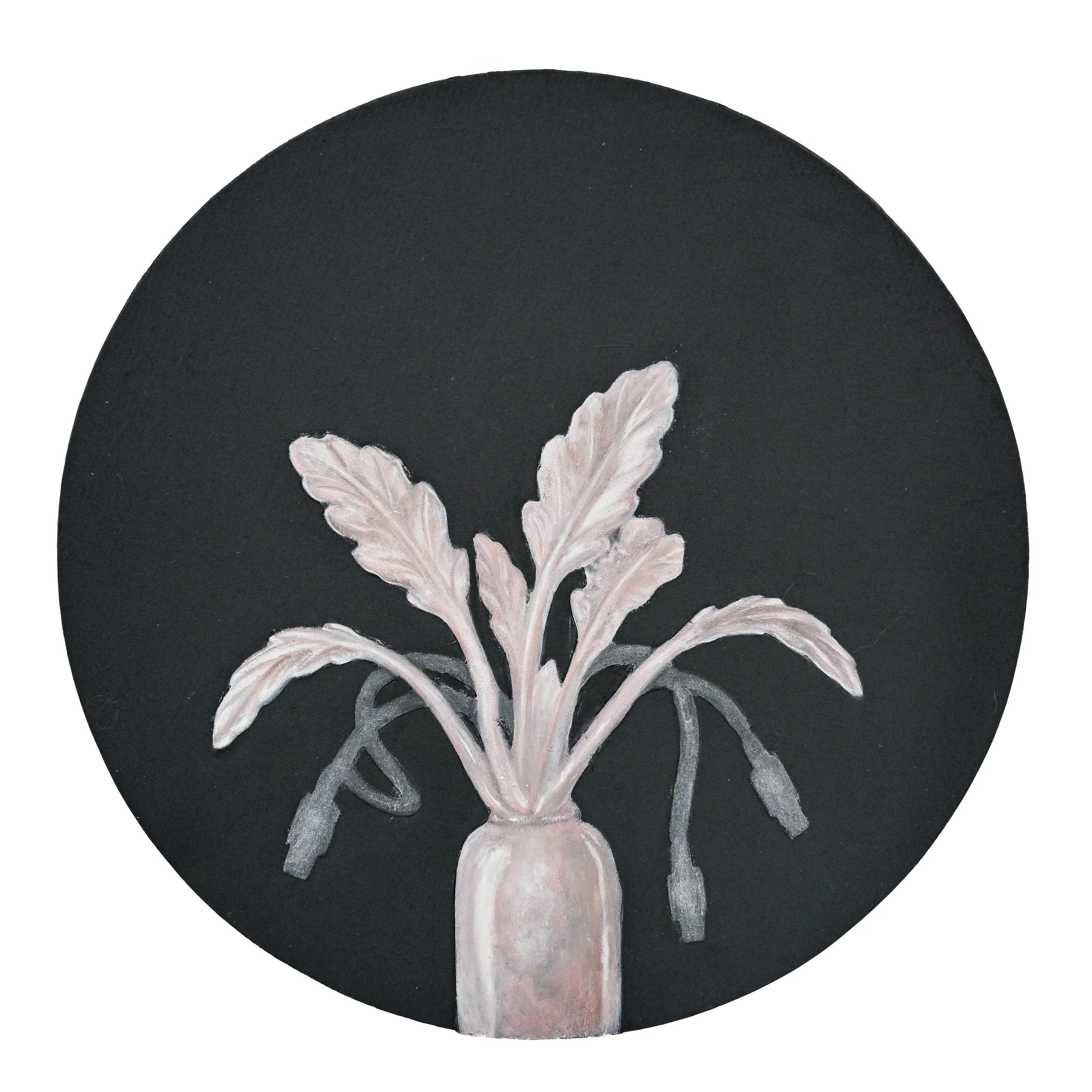
And then the surface refuses to behave. It isn't smooth; it's two millimetres of built matter, carved and layered and slow. It doesn't glow from behind glass; it catches whatever light is actually in the room, so it shifts as you move and is never the same twice. And under the softness there is something wrong — a blade laid along skin, a hardness where the eye expected to sink in. The eye arrives trained to skim, to appraise, to want and move on, and the painting simply won't let it finish the motion. It has to stop. It has to stay longer than it meant to.
That held second is the whole ambition. In it, something small happens: you notice that you were looking. The trained eye, which normally does its work in the dark, gets caught in a little light. You catch yourself wanting — and catching yourself is already a different act than wanting.
It matters to me that I'm the one arranging the display, because I have also spent time on the other side of the counter: sorted, graded, handed a picture of what a precious young woman is meant to look like. Making these is a way of taking the arranging hand back — not to look the way I was taught, but to look at the looking. To set the offering down and, in the same gesture, ask who taught you to find it so easy to consume.
I'm not naïve about the scale of this. One dense painting doesn't dismantle the machinery that trained us; the feed will still be there when you put your phone back in your pocket, and it is patient, and it is winning. What I can make is friction — a surface stubborn enough that, for a second, your eye doesn't know what to do with it. And in that not-knowing you are seeing again, instead of only recognizing. It's a small stall in a very large machine. But you have to catch your eye in the act before you can begin to choose what it does, and the stall is where the catching becomes possible — for a second, before the machine starts up again.
